
Griffith Institute, University of Oxford
The Griffith Institute holds one of the world’s most important Egyptological archives: the excavation records created by Howard Carter and his team during the discovery of Tutankhamun’s tomb in the 1920s.
For years, this material had been digitised and published online, but as static html folders. It was hard to search, and all links between records had to be hand-coded.
The Institute asked Agile Collective to help transform decades of archival material into something more useful: a structured, searchable archive that researchers could work with, and which would also make the collection more accessible to the public and media with a general interest in ancient Egypt.
The Challenge
The existing site reflected how the archive had grown organically over decades:
- Records lived in folders rather than relationships.
- Naming conventions varied.
- Cross-referencing depended on human memory.
- Researchers needed multiple tabs open to reconstruct context.
At the same time, the Institute wanted to:
- Secure funding from the John Fell Fund.
- Explore what a “spatial archive” might mean.
- Serve both specialist researchers and a wider audience.
The ambition was large, but the clock was ticking as the centenary of the unwrapping of the body was in November, and we wanted the site online in time for that.
The Turning Point:
Discovery
Before proposing solutions, we ran a focused discovery phase.
We investigated two things in parallel:
1.The data reality
- What actually exists?
- What is consistent?
- What can be modelled cleanly? What cannot?
Are there any existing systems that would suit our needs?
2. Real user behaviour
- How do Egyptologists actually use the archive?
- Where do they get stuck?
- What would they like?
- What are general users searching for? (Google Analytics and Tag Manager)
- What are other stakeholders (Google Arts, educators) interested in?
Three insights became clear:
- Although the collection contains records rather than the objects themselves, the object would have to be the core reference unit.
- The Archive has two distinct focuses: the tomb and the time of Tutankhamun on one hand; the world of Egyptology in the 1920s.
- Visualisations and stories must only be drawn from material actually in the collection.
These shaped everything that followed.
What We Built
An Object-Centred Database
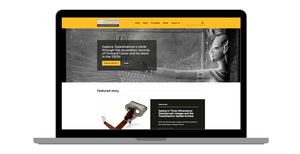
We rebuilt the archive in Drupal, anchored around structured object records.
Each object now acts as a hub for:
- Images
- Object cards
- Notebook references
- Conservation records
- Related items
Researchers can move laterally across material without getting lost in file hierarchies.
Search Designed for Specialists
Rather than replicating the browse-first experience of the old site, we prioritised search. Specialists arrive knowing exactly what they want, but not always the exact ID or terminology.
The new system supports:
- Structured metadata
- Cross-referencing
- Filtering by record type
- Interlinked navigation
The result: significantly faster traversal between related records.
Sustainable Infrastructure
We chose Drupal deliberately:
- Complicated content relationships could be created quickly.
- Security updates are manageable internally.
- Structured content can be reused in future formats.
- Outputs cleanly to other databases via an API.
Automated Migration
The archive contains thousands of records. Whilst much of the content had to be copied by hand as it needed to be reviewed. However, for images and certain other data, we built repeatable import pipelines using Drupal’s migration framework.
The client team prepared spreadsheets. We run structured imports. Data lands consistently, saving months of manual effort.
Public-Facing Stories
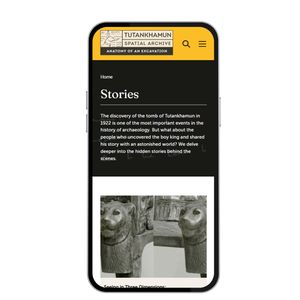
In order to draw in a wider audience, and to highlight significant parts of the collection, we devised a Stories section.
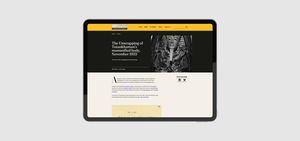
This allows the Institute to publish curated narratives, including material tied to the centenary of the 1925 unwrapping, and a 3D model of Tutankhamun’s mask built by scanning original photographs, without separating scholarship from public engagement.
Launch and impact
The archive launched publicly in November 2025, marking 100 years since the unwrapping of Tutankhamun’s mummy.
The static folder system has been replaced by a structured, interlinked database.
Early specialist feedback highlights:
- Faster navigation between related materials
- Clearer object-centred structure
- Improved cross-referencing
- A visual design that makes the site pleasurable to use, as well as attracting a new audience.
The Institute now has:
- A maintainable platform
- A foundation for incremental spatial work
- A system that can grow without rebuilding from scratch
Afterthoughts
The main aim of the project was to reshape what already existed into something coherent, more usable, and sustainable - for generations of scholars to come.
But the secondary aim was to make the collection visible and legible to a broader audience.
We couldn’t have succeeded without the extraordinary efforts and flexibility of Lara Bampfield, Daniela Rosenow and the rest of the team at the Griffith institute!