
War on Want site rebuild
War on Want is an international campaigning charity that works in solidarity with social movements to challenge the root causes of poverty and injustice.
Their website explains complex global issues, shares research, and mobilises campaigners to take action. Over time, the site had accumulated a large volume of content and evolved in ways that didn’t always meet user needs.
War on Want asked Agile Collective to help them better understand their audiences to support the organisation’s communications and campaigning goals.
Between August and December 2025, we worked together through a discovery, design and targeted build process. The project focused on aligning the website’s content and structure with real user behaviour to improve clarity, discoverability and engagement.
Objectives
The project had four core objectives:
- Understand how people use the website - using analytics, research and testing to identify key audience groups and their needs.
- Improve content structure and discoverability - ensuring users can find explainers, reports and other key resources quickly.
- Support better user journeys - helping visitors move from reading content to deeper engagement with War on Want’s work.
- Strengthen the site’s role in communications strategy - positioning the website as a gateway that builds trust and encourages people to join ongoing communications channels such as email.
Importantly, the work was designed as a targeted improvement programme, rather than a full redesign. War on Want wanted practical improvements that could deliver impact now, but were flexible enough to accommodate a new comms strategy the following year.
Process overview
Discovery and research
We began with a discovery phase that combined quantitative data, qualitative research, and internal consultation.
Activities included:
- Full content audit of organisational, campaign and analysis content
- Analytics review to understand traffic sources, entry pages and user behaviour
- User surveys with supporters, website visitors and staff
- User interviews across different audience groups
- Usability testing on key content journeys
- Audience segmentation based on behaviour and motivations
- Internal workshops with War on Want staff to understand strategic priorities
This work produced a detailed picture of who uses the site and why.
Three key audience groups emerged:
- Discoverers
The largest group of visitors. They typically arrive via search engines, looking for information about an issue and read a single article before leaving. They are politically engaged but may not yet be familiar with War on Want.
- Specialists
Researchers, partners, journalists or funders looking for specific reports, briefings or organisational information.
- Existing supporters
Those who primarily engage via email and campaign platforms usually arrive at the site via direct links rather than by browsing.
This insight helped clarify the website’s role, to inform and build trust with new and specialist audiences, and encourage them to join longer-term communications channels.
Design and targeted build
Using the discovery findings, we worked with War on Want to identify high-impact improvements that could be implemented quickly.
These focused on:
- prioritising evergreen explanatory content
- improving access to research and reports
- creating clearer pathways to engagement
- simplifying and consolidating the site’s content
Challenges
High search traffic but shallow engagement
Most visitors arrived via Google searches and read a single article before leaving. Many of these pages contained valuable information but were written as time-bound news articles rather than accessible explainers.
This meant the site was missing opportunities to convert new visitors into longer-term supporters.
Key research content was hard to find
War on Want produces influential reports and briefings used by journalists, academics and policymakers.
However, usability testing showed that specialist users struggled to locate these documents quickly, partly because they were buried within broader “resources” sections.
Content sprawl and outdated material
Years of campaigning had resulted in a large archive of PDFs, campaign pages and media content. Some was outdated or duplicated, which diluted the visibility of high-value content and made the site harder to navigate.
High-barrier calls to action
Many calls to action on the website encouraged visitors to immediately take part in campaign activities. But discovery research showed that new visitors were often not yet ready to take direct action.
They needed context and trust first.
Solutions
Promoting explainer content
We identified high-performing articles that functioned as evergreen explainers and reclassified them accordingly. This helps turn search traffic into deeper engagement by guiding visitors through connected content.
Changes included:
- highlighting explainers across topic pages
- refining page templates for better readability
- creating structured internal linking between explainers and related content
- reducing the prominence of time-bound news articles
A clearer pathway to engagement
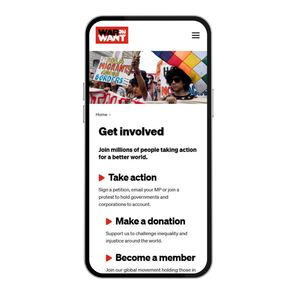
The newsletter signup became the primary call to action in key areas of the site.
Instead of pushing immediate campaign participation, the website now supports a softer conversion journey:
Article → Learn more → Sign up → Receive actions via email
This reflects how supporters actually engage with War on Want’s campaigning work.
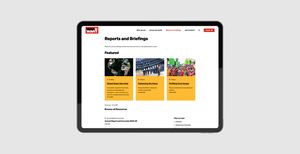
A dedicated reports and briefings hub
To support specialist audiences, we created a new Reports & Briefings section with a clearer taxonomy, including:
- Reports
- Briefings
- Joint letters
- Activist resources
- Annual reports
Improving topic pages
Topic pages were redesigned to better support learning journeys.
Changes included:
- clearer topic introductions
- replacing news-heavy listings with explainers and key reports
- removing outdated campaign materials
- strengthening internal linking
Content consolidation and pruning
We undertook a significant content clean-up, removing outdated PDFs, duplicate pages and obsolete campaign material.
This reduced noise across the site and helps search engines better prioritise high-quality pages.
Improvements to article templates
News and analysis templates were refined to improve readability and encourage deeper journeys.
Enhancements included:
- clearer standfirsts and improved typography
- stronger contextual linking
- improved filtering on listing pages
These changes make long-form articles easier to engage with and better connected to related content.
Outcomes and impact
The project delivered a series of targeted improvements that strengthen the website’s role in War on Want’s communications strategy.
Key outcomes include:
Stronger engagement pathways
Visitors arriving via search are now guided towards explainer content and encouraged to subscribe to email communications — building a longer-term supporter base.
Improved access to research
The new Reports & Briefings hub makes it significantly easier for specialist audiences to locate evidence and flagship publications.
Clearer content journeys
Better linking between topics, explainers and analysis encourages users to explore multiple pages rather than leaving after a single article.
Higher quality content ecosystem
Removing outdated and duplicate material has simplified navigation and improved the signal-to-noise ratio across the site.
A foundation for future strategy
Perhaps most importantly, the work provides War on Want with a clearer understanding of how their audiences interact with the website. This evidence base will help inform the organisation’s next communications and digital strategy.